I. The birth of the Unipolar Moment
On Christmas Day in 1991, Mikhail Gorbachev gave a televised speech announcing his resignation as President of the USSR and the Soviet flag was lowered from the Kremlin for the final time. For a major part of the twentieth century, the Soviet Union had stood as one of the two poles around which international politics revolved, with its military power stretching across Eurasia, its ideology influencing movements internationally, and its rivalry with the United States shaping almost every major geopolitical event of the post WWII era. However, when the Soviet state finally collapsed, it happened with remarkable speed. A major global superpower that had appeared permanent only a few years earlier suddenly disappeared, leaving the United States in a position that few great powers in history had ever enjoyed.
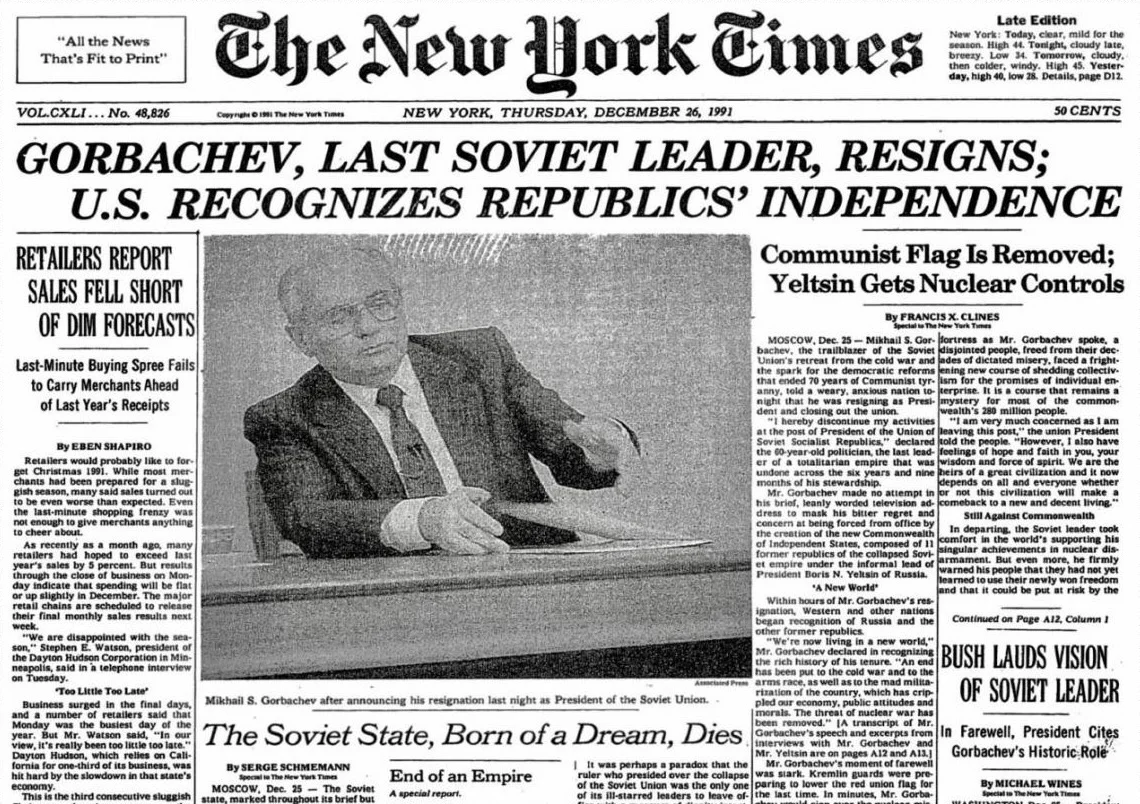
The significance of this moment extended far beyond the borders of the former Soviet Union. The collapse of America's principal rival created a strategic environment unlike any that had existed in the modern era. Previous great powers had always operated in the presence of competitors. Some notable examples are the British Empire that spent much of the nineteenth century managing the ambitions of rival continental powers and the Imperial Germany, which confronted a coalition of major European states determined to prevent its domination of the continent. Even at the height of its influence, the United States had measured itself against the Soviet Union. After 1991, however, no comparable challenger existed. The American military spending dwarfed that of its potential rivals, its navy controlled the world's most important maritime routes, its financial system sat at the center of the global economy, and its alliances spanned across Europe, Asia, and the Middle East. For a brief period of time, the United States occupied a position of dominance that was historically extraordinary.
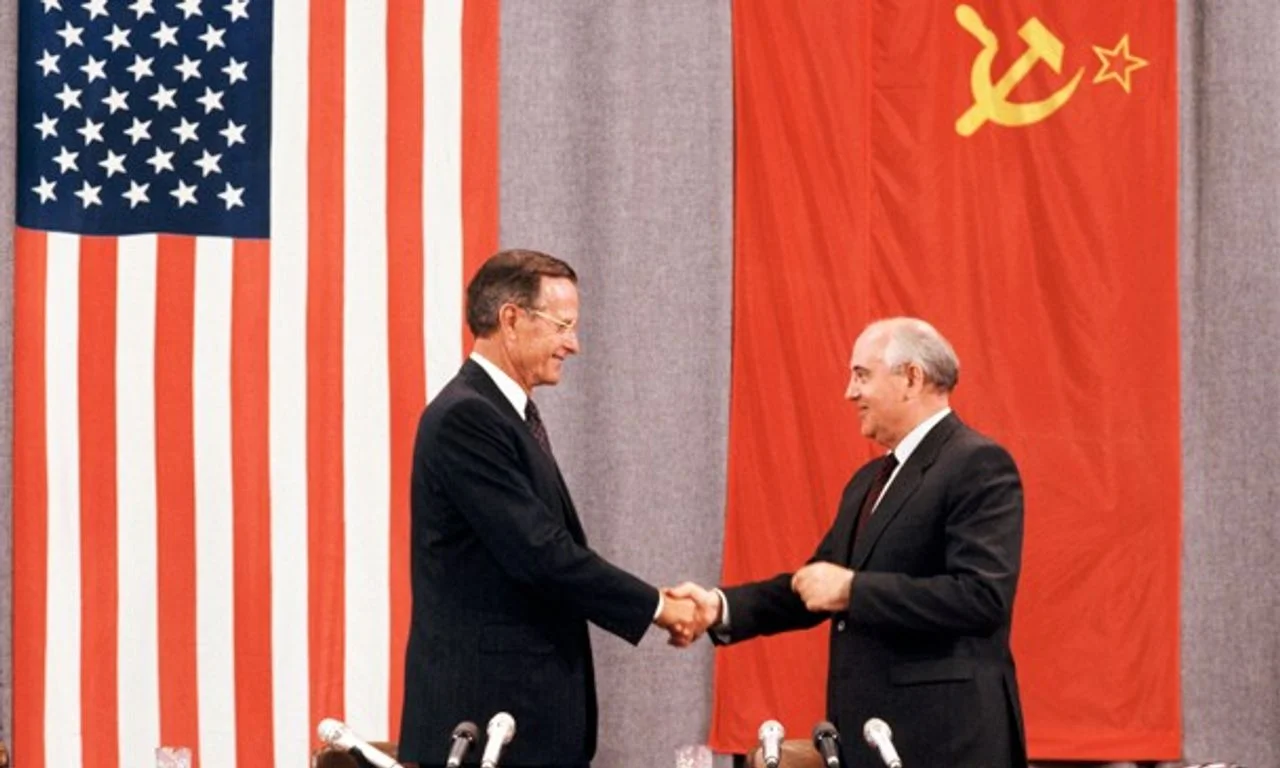
Source: World Socialist Web Site (wsws.org), published by the International Committee of the Fourth International (ICFI).
The problem with extraordinary circumstances though is that people rarely recognize them as such while they are living through them. A period of stability increasingly stops appearing exceptional and instead becomes the baseline against which everything else is measured. However, there was nothing normal about the strategic environment that emerged after the fall of the USSR. Previous generations of American leaders had spent their entire careers confronting peer competitors. They understood a world defined by balance-of-power politics. They understood deterrence, containment, arms races, and spheres of influence. In contrast, the generation that followed inherited an unusual international order, in which no serious challenger existed to contest the Western preeminence.
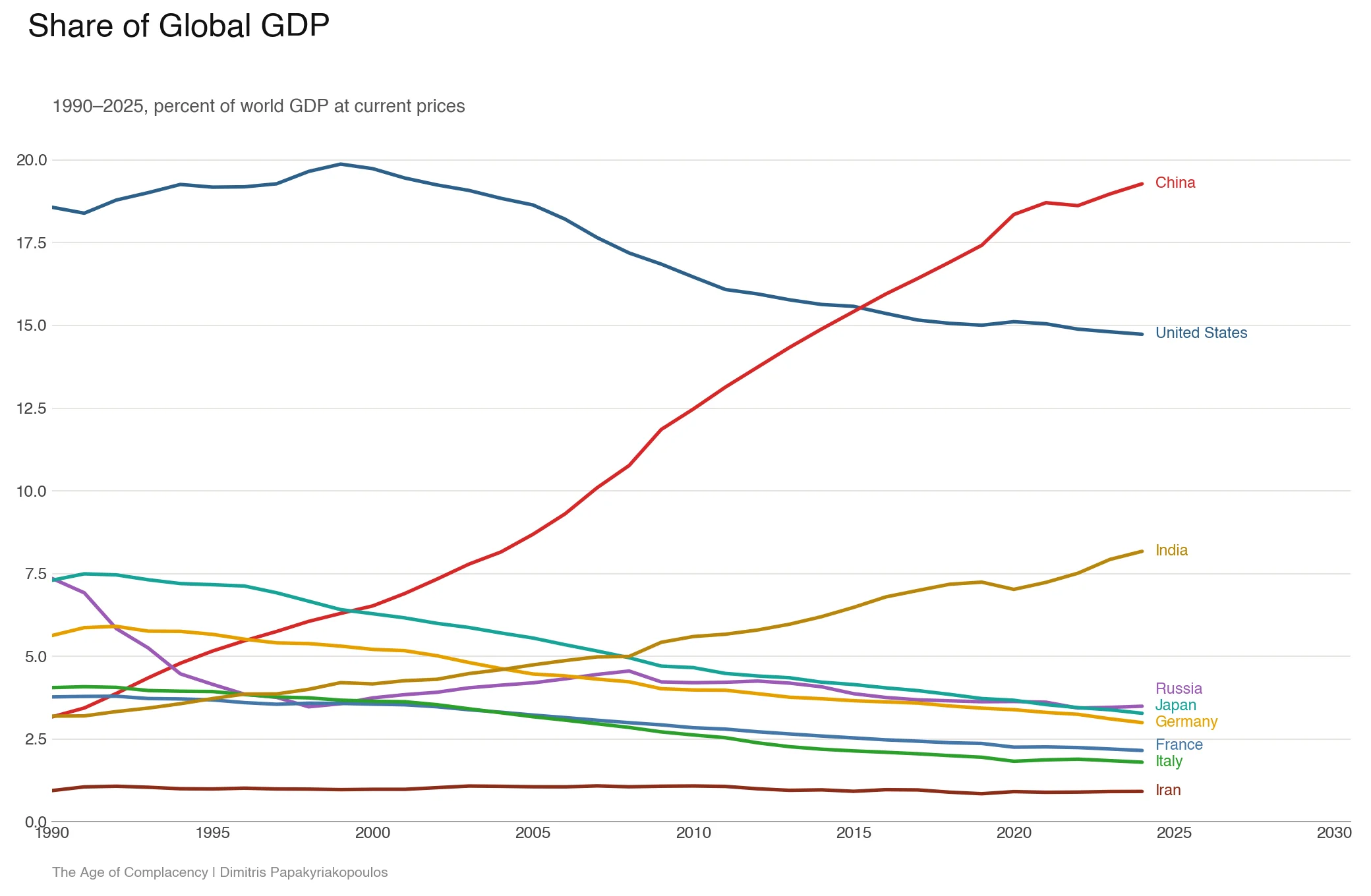
Source: World Bank. World Development Indicators.
The distribution of global economic output from 1991-2000 reveals the extent of this western dominance. In the years following the Soviet collapse, the United States remained the central pillar of the world economy. While Japan entered a prolonged period of stagnation and Russia struggled through economic collapse, the American economy continued to expand. China was growing rapidly, but it remained far from challenging the economic scale of the United States. Combined with the economic weight of Western Europe, the broader Western alliance accounted for a substantial share of global output, technological innovation, and financial activity.
Power, however, is never measured solely in dollars, since historically, wealth has often proved to be fleeting. The states that shape international orders are not simply those that generate prosperity, but those that possess the abilities to protect it. And the extraordinary nature of the post-Cold War order was nowhere more evident than in the military dominance that emerged after 1991.
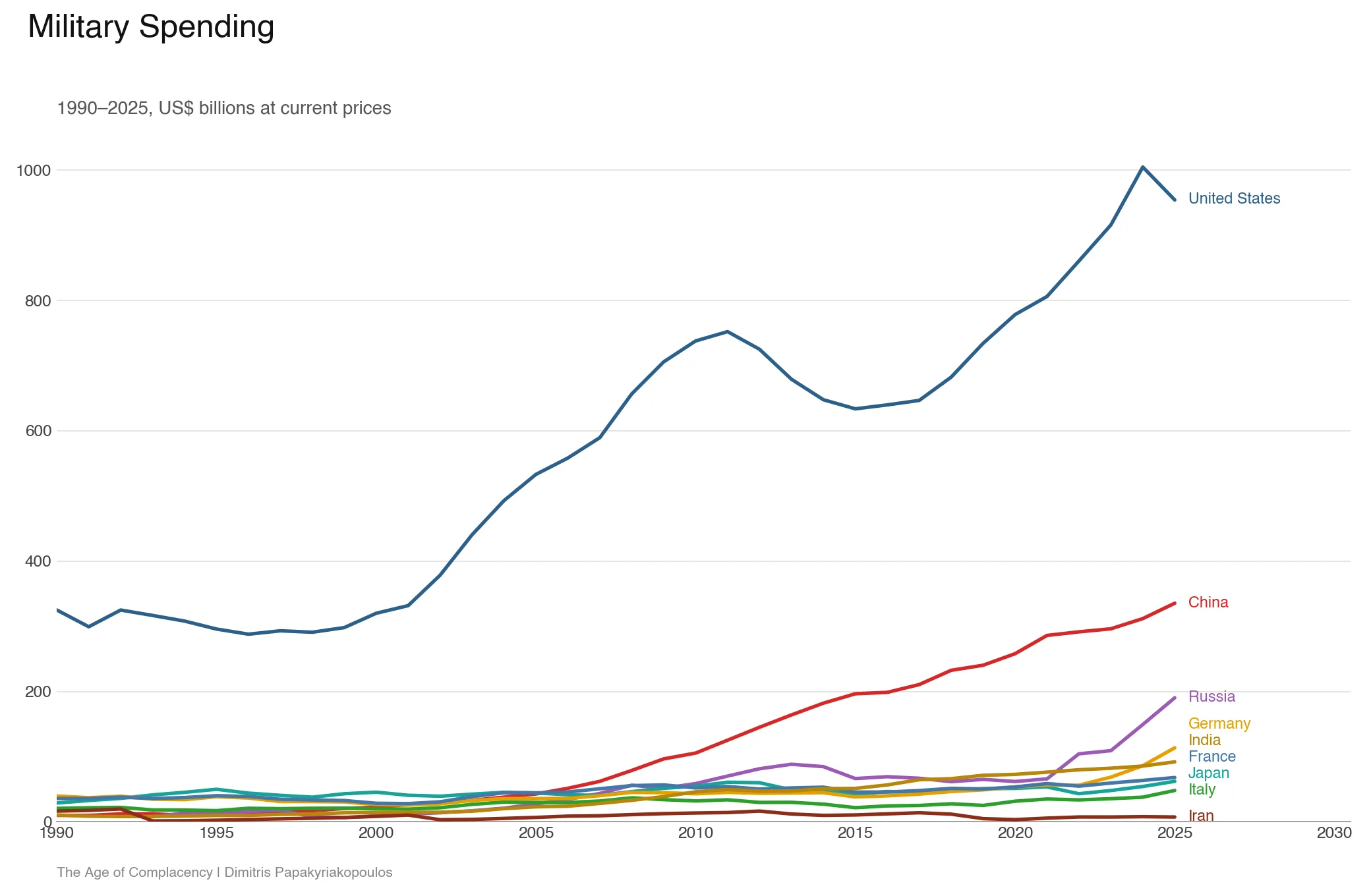
Source: SIPRI Military Expenditure Database.
The military imbalance of the post-Cold War era was unlike anything most strategists had previously experienced. The United States spent more on defense than multiple major powers combined. Its navy operated across every ocean, its air force possessed capabilities that competitors struggled to replicate (or sometimes to even fathom) and its defense industrial base remained unmatched in sophistication and scale. When American forces were deployed abroad, they did so with a level of logistical reach that no other state could ever approach.
The Gulf War offered a glimpse of this reality and to observers around the world, the conflict appeared to reveal a new model of warfare. Precision-guided weapons struck targets with astonishing accuracy, satellites connected forces across vast distances and advanced aircraft operated with a degree of effectiveness that seemed almost futuristic. The war was brief, decisive, and overwhelmingly one-sided. For many policymakers, America appeared to be pulling further ahead of its potential adversaries in both technological and military power.
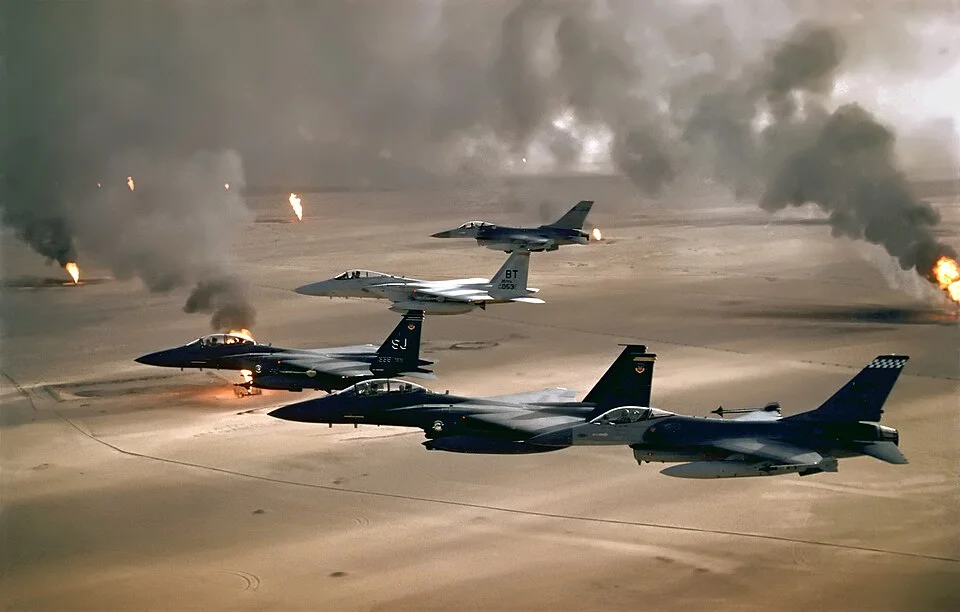
Source: Wikipedia Commons.
By the early twenty-first century, many political leaders, business executives, academics, and ordinary citizens had spent their entire adult lives inside a world shaped by overwhelming Western dominance. This may have been the most important consequence of the Unipolar Moment as it encouraged people to confuse a particular distribution of power with the natural course of history. What had been created by geopolitical circumstances progressively came to be viewed as an enduring feature of the international system. The longer the period lasted, the stronger this assumption became. Success reinforced confidence, confidence shaped expectations and expectations influenced policy. This is what we are taught in Computer Science as confirmation bias.
This shift in perception would ultimately prove more consequential than any single policy decision. The greatest legacy of the post-Cold War era was not merely the expansion of globalization or the spread of liberal institutions. It was the gradual emergence of a set of assumptions about how the world worked. Competition appeared less important than cooperation. Economics appeared more important than geopolitics. Efficiency appeared more valuable than resilience. Military power seemed increasingly secondary to technology, finance, and trade. Don’t get me wrong, these assumptions were not irrational, in fact in many respects they reflected the realities of the moment. However, they were built upon a geopolitical environment that was itself unusual, and perhaps even temporary.
The story of the last three decades is therefore not simply a story about Western success. It is also a story about what success can do to societies. Victory removes pressures. It changes incentives, alters priorities. Most importantly, it reshapes expectations about the future. The end of the Cold War did not merely transform the international balance of power, but it instead transformed the way an entire generation thought about power itself.